



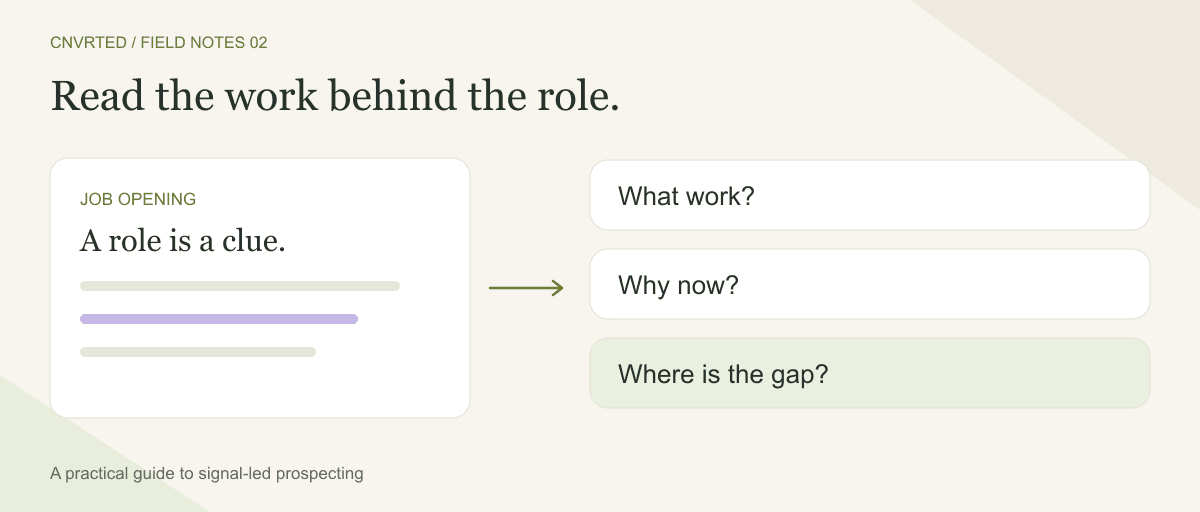
A hiring signal is a job opening or hiring announcement that suggests a company is investing in a particular kind of work. For sales research, the useful information is usually in the responsibilities, tools, and expected outcomes. A vacancy alone does not establish purchasing intent, an external vendor budget, or a willingness to outsource.
Consider a company hiring a marketing operations manager. The role might exist to build a new function, replace someone, consolidate agencies, or maintain an established system. Those explanations lead to very different outreach decisions. Your research should narrow them before your message assumes one is true.
Read responsibilities before titles
Titles are inconsistent across companies. Instead, look for the task that overlaps with your offer: migrating a CRM, establishing lifecycle reporting, improving onboarding, or managing a new region. Save the original job URL and a short excerpt that supports your interpretation. Keep the date you checked it alongside any publication date the source provides.
| Observed requirement | Question to investigate |
|---|---|
| Own a CRM migration | Is the platform chosen, and is outside implementation support wanted? |
| Build the first customer-success process | What exists today, and what must wait for the new hire? |
| Launch a regional sales team | Is there a confirmed launch, with a market you can serve? |
| Bring paid acquisition in-house | Would your agency conflict with the stated direction? |
| Maintain existing reporting | Is there a change underway, or ordinary ongoing work? |
The last two rows matter. Research should help you reject an attractive-looking account when your service is a poor match. A company hiring an internal specialist may want less outside support. Do not convert that evidence into ‘they are overwhelmed and need us’ without a separate reason.
Check freshness and find a second piece of context
Check the original careers page. Confirm the vacancy is still open. A copied listing on a job board can outlive the role. A refreshed listing date may reflect a repost rather than a new initiative.
Read the surrounding announcements. Look for a launch, a team expansion, or a leader describing the same project. Two job boards repeating one advertisement are still one source.
Identify the responsible function. The recruiter may know the vacancy but may not own the project you can help with. Find a credible workstream owner without assuming a senior title means purchase authority.
Look for evidence against your hypothesis. An already completed migration, a closed vacancy, or an explicit move in-house can change your decision. Record it instead of burying it in the notes.
You will not always establish whether a role is a backfill. Mark that as unknown. Uncertainty should change the wording of your question; it should not become a made-up fact in a personalized email.
A worked example: three accounts, three decisions
Imagine you provide onboarding documentation for B2B software teams. These companies and circumstances are fictional. Cedar Systems advertises a first customer-success hire and its founder discusses inconsistent handovers. That combination gives you a reason to ask whether documenting the current process would help the incoming hire.
Harbor Apps advertises the same title but says the hire will maintain a mature onboarding library. You have no evidence that your documentation service addresses a current gap. Hold the account. Lumen Works explicitly says it is replacing outsourced onboarding support with an internal team. Exclude it from this particular offer unless new evidence changes the situation.
A possible opening for Cedar: ‘Your customer-success role mentions standardizing handovers, and your recent post raised the same issue. Would mapping the current handover before the new hire starts be useful, or is that already covered?’
This opening describes the evidence and leaves room for correction. It does not claim that the company is struggling, that the hire has a fixed start date, or that you know its budget. If you offer a process map, be ready to explain what inputs you need and what the team would receive.
Save a research note another person can inspect
- Company and role; original job URL; date checked; current open or closed status.
- Relevant responsibility in the listing and the business problem it might indicate.
- Independent supporting context, with its own source and date.
- Contradicting evidence and questions you still cannot answer.
- Decision: contact, research further, hold, or exclude; with one sentence explaining why.
How quickly should you act? There is no universal number of days. A current project with an unresolved gap deserves a different response from a months-old evergreen vacancy. Recheck the evidence before outreach. How many open roles make a company qualified? No count does that on its own: the work and your fit matter more than the number of advertisements.
Combine hiring with other buying-signal examples, then use the agency outbound playbook to turn a verified gap into a bounded offer.