



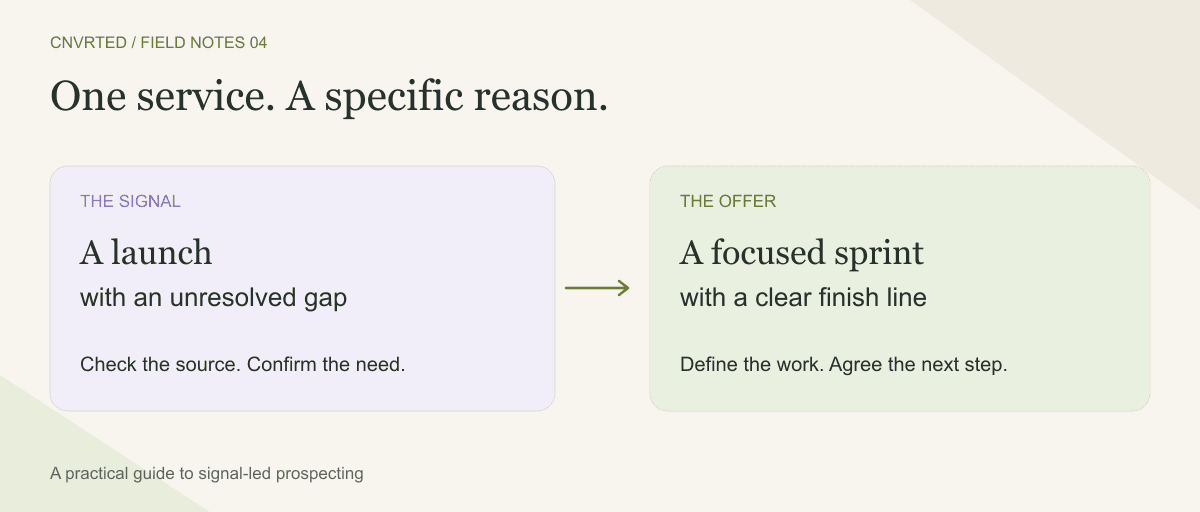
Signal-based outbound for agencies starts with an observable client event, checks whether it creates a problem your service can solve, and proposes a specific next step. It works as a planning method when the agency has a clear offer and rejects accounts where the evidence does not support that offer. A recent announcement alone is not a brief.
The examples below are fictional operating plans, not reported customer campaigns or conversion benchmarks. Adapt the service, delivery constraints, and messages to work your agency can actually perform. For the underlying structure of trigger, segment, motion, and outcome, start with what a GTM play is.
Pick one service your team has room to deliver
An agency that offers websites, branding, paid acquisition, and operations support does not need to sell all four in one message. Choose a service with a recognizable starting problem, a defined deliverable, and credible proof. Confirm who would do the work if prospects said yes this week.
A two-week landing-page messaging sprint is easier to evaluate than ‘a growth partnership.’ That does not make two weeks the right duration for every agency. The point is to specify the work and dependencies, including access, stakeholder availability, and revision limits, before creating demand for it.
Play one: a launch with an unresolved messaging gap
- Service: a messaging and landing-page sprint for B2B software companies.
- Trigger: a company announces a new product or audience it is entering.
- Evidence to check: the announcement and live page address different audiences, or the owner publicly asks for feedback on positioning.
- Offer: a short review of one page, followed by a scoped paid sprint if the problem is confirmed.
- Stop rule: the launch is cancelled, the owner says the work is covered, or your observation does not survive a closer read.
An unfamiliar design is not evidence of a failing page. Look for a concrete mismatch you can describe respectfully. In a fictional example, Fern Analytics announces a finance-team product, while the linked landing page still explains only its older developer tool. You can ask about that mismatch without guessing its conversion rate.
‘I saw the finance-team launch. The linked page still leads with the developer workflow — is a separate finance page already on the way? If useful, I can send a short outline for explaining the new use case.’
Prepare the outline before offering it. Keep it bounded: the audience, the problem, the proof required, and a proposed page structure. Do not spend days creating an unsolicited redesign or imply that a speculative mock-up is a commissioned project.
Play two: a new hire who may need a clean handover
- Service: documenting customer onboarding for small software teams.
- Trigger: a first customer-success role, paired with public discussion of inconsistent handovers.
- Evidence to check: the role is current, the responsibilities match the problem, and there is no indication that outside help is unwanted.
- Offer: a current-state handover map and a prioritized documentation plan.
- Stop rule: the role is a routine replacement, the process is already documented, or the company is deliberately moving the work away from agencies.
Your service should complement the hire rather than suggest replacing them. Ask whether a process map would help the new owner start with fewer unknowns. Do not claim that recruiting proves a capacity crisis. The hiring-signals guide explains how to distinguish useful context from assumptions.
Give each account a one-page brief
Before someone sends the first message, the brief should identify the account, service fit, source URL, event date, verified gap, and relevant owner. Add a sentence of counter-evidence, even if it is simply ‘we do not know whether an internal team already owns this.’ Finish with the proposed deliverable and the question that would confirm whether it is useful.
Have the person responsible for delivery review the first few briefs. They may catch a missing dependency that a salesperson cannot see: a migration requiring specialist access, an approval chain that makes the proposed schedule unrealistic, or a problem that needs engineering before design work can help.
Run a bounded pilot and inspect the handoff
Research a manageable batch. Keep the service and audience consistent enough to learn from the results. Save rejected accounts and reasons as well as accepted ones.
Send the specific question. Use the source accurately, offer something real, and let the recipient correct your interpretation. Respect a request to stop.
Follow up only with a useful addition. For example, clarify the scope or share the promised resource. Close the outreach after your limited follow-up plan; silence does not justify indefinite contact.
Qualify the work before quoting. Confirm the owner, inputs, desired outcome, approval process, price fit, and capacity. A booked meeting alone does not make a good project.
At review, ask where the play failed: no relevant events, weak fit, a mistaken problem, an unwanted offer, or delivery constraints. Change the earliest broken step. Sending more messages will not fix a service that requires access clients cannot provide. Track meetings held and projects accepted alongside research and delivery hours.
Use the outreach metrics guide to compare plays on consistent terms. If you are still defining your audience, return to the first-customer research plan.