



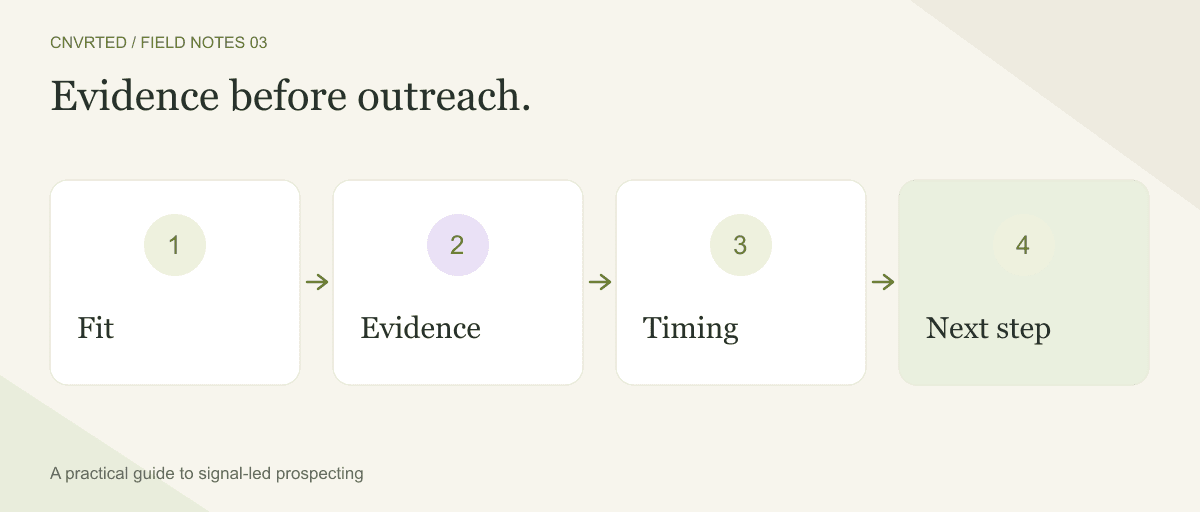
Before sending a cold email, check whether the company fits your offer, whether there is credible evidence of a relevant problem, and whether the person is connected to that work. Record what you still do not know. The result is a decision about whether to start a conversation, not a claim that the prospect is ready to buy.
This distinction prevents a common mistake: filling a spreadsheet with guessed budget, urgency, and authority, then treating it as qualification. Public research can establish some facts. Other questions require a conversation with the people doing the work.
Separate outreach readiness from sales qualification
Salesforce describes BANT as budget, authority, need, and timeline. Those are useful areas to explore as a sales conversation develops. Before contact, you may only have partial evidence of need and timing. Funding is not the same as an allocated budget, and a department title does not confirm approval authority.
Use a smaller pre-outreach decision: can you explain why this account, why this issue, and why your contribution would be useful? If the explanation depends on assumptions you cannot name, the account needs more research.
Use four gates before drafting
Fit: can we serve them? Check the business model, required tools, geography, and delivery constraints that matter to your offer. A strong signal cannot compensate for a requirement you cannot meet.
Evidence: what actually happened? Find the original source. Record the event and date, then write the possible implication separately. A direct request for help and a generic company announcement deserve different levels of confidence.
Timing: is the situation still open? Read updates and replies. Check whether the project was completed, the role filled, or a vendor selected. Do not manufacture urgency from an old event.
Relevance: can this person act on the message? Identify the function involved and a plausible owner. Define a helpful next step you can genuinely provide. ‘Book my demo’ is not a reason the buyer needs one.
Use gates rather than a score that hides serious failures. A prospect can earn points for company size, funding, and engagement while still requiring a capability you do not offer. That account should not reach the outreach queue because its total looks impressive.
Route the account into one of four queues
| Queue | Decision rule | Next action |
|---|---|---|
| Contact | Fit and evidence support a useful question | Recheck the source and draft a specific opening |
| Research | One material fact could change the decision | Name that fact and where to verify it |
| Hold | Relevant account, but no current reason to act | Record the event that would justify revisiting |
| Exclude | Cannot serve them, or outreach is unwanted | Record the reason and prevent repeat outreach |
Set a practical research limit for your team. If ten minutes is your starting budget per account, use it to answer the most consequential uncertainty first. This is an operating choice, not a best-practice benchmark. Repeatedly failing to find the same information may mean your selection criteria are too ambitious.
A research note that becomes a better email
Here is a fictional example for a service that helps software companies improve trial onboarding. MapleDesk’s product lead publicly asks how other teams investigate setup abandonment. Its product matches the workflow you support. You have not seen internal conversion data, and you do not know whether a project is funded.
Observed: product lead asked about investigating setup abandonment in a current public discussion.
Hypothesis: the team may benefit from a structured review of the setup flow.
Unknown: size of the problem, existing owner, access requirements, budget.
Decision: contact with a diagnostic question and a small, relevant resource.
A suitable email could say: ‘Your question about investigating setup abandonment caught my attention. Are you trying to identify the sticking point, or have you already found it? I have a short walkthrough checklist for separating confusing steps from technical failures. Happy to send it.’ Use this only if the checklist exists and fits your actual expertise.
Avoid claiming that you spotted lost revenue or that the team’s onboarding is broken. The public question supports neither claim. If the reply says the issue is already resolved, update the account record rather than trying to force a discovery call.
What to confirm once they respond
Move from public clues to the buyer’s account of the problem. Ask what happens today, why it matters, what they have already tried, and who would participate in a change. Then discuss commercial fit and timing in context. Preserve their language in your notes so the next person does not turn a tentative interest into an invented commitment.
What if no budget is public? Mark it unknown; most public research will not answer that question. What if the contact is not the decision-maker? They may still understand the workflow, but ask how decisions are made before treating them as an approver. Qualification becomes more reliable when the record can distinguish a fact, an inference, and a buyer-confirmed answer.
See the signal-to-outreach walkthrough for the broader flow, then measure qualified conversations instead of counting every reply as progress.